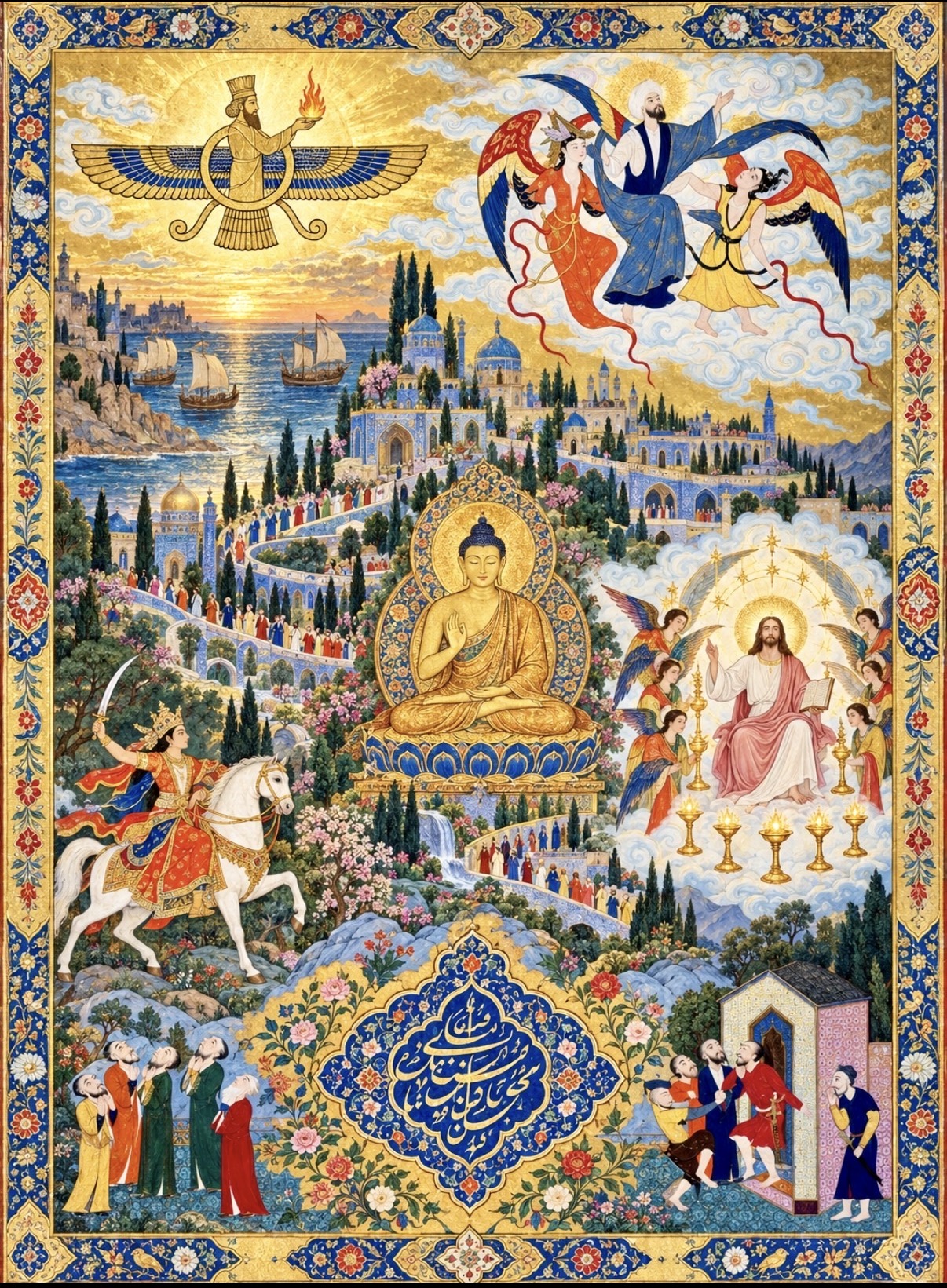
What you’re describing is one of the most fascinating recurring themes in the world’s religions: the coming of a future saviour, a world-restorer, or an enlightened figure who will bring an age of truth, peace, and justice.
Across thousands of years, different civilizations have preserved prophecies about someone who comes when humanity has fallen into darkness.
But there is an important mystery here: Are all these traditions describing the same figure under different names, or are they expressing a shared human hope?
Let’s look at the connections.
The seven traditions and their promised figures
1. Zoroastrianism — Saoshyant (Sōšyāns)
The future benefactor or saviour. He will help bring about the final victory of truth over evil, the resurrection of the dead and the renewal of existence, known as Frashokereti.
Ancient Persian tradition.
2. Hinduism — Kalki
The future tenth avatar of Vishnu, expected at the end of Kali Yuga. He is associated with the destruction of unrighteousness and restoration of Dharma (cosmic and moral order).
Indian tradition. Kalki is Hindu, not Zoroastrian.
3. Judaism — Mashiach
The Anointed One, traditionally expected to be a future king descended from David, associated with restoring Israel, justice, peace and knowledge of God.
4. Buddhism — Maitreya
The Buddha of the future, who will appear when the teachings of the present Buddha have faded, rediscover the Dharma and guide humanity towards enlightenment.
5. Christianity — The Second Coming
Jesus Christ returns as the Son of Man, associated with the final judgment, resurrection, defeat of evil and establishment of God’s kingdom.
6. Islam — Imam al-Mahdi
The rightly guided one, who will emerge near the end of time and establish justice after oppression and injustice have spread. Beliefs about his identity and role differ between Sunni and Shia traditions.
7. Islam — Jesus (Isa al-Masih)
Jesus is also expected to return in Islamic eschatology. In many Islamic traditions, he plays a role in defeating falsehood and establishing justice.
These figures share themes, but they are not interchangeable. Each tradition has its own understanding of salvation, time, divine intervention and humanity’s future.
The deeper connection: why do these stories resemble one another?
There are three particularly interesting common themes:
The age of darkness: Humanity enters a period of corruption, injustice, ignorance or spiritual decline.
The arrival of a restorer: A promised figure appears, bringing truth, wisdom or divine guidance.
The renewal of the world: Evil is overcome, justice is restored, and humanity enters a transformed era.
This resemblance is a genuine subject of comparative religious scholarship. There are also historical questions about how ancient Persian religious ideas may have influenced later Jewish and Christian apocalyptic thought.
But who is he?
There are three ways to approach that question:
The theological interpretation: Each religion is describing its own promised figure.
The historical interpretation: Similar expectations developed through cultural contact, shared stories and historical circumstances.
The mystical interpretation: These figures represent one universal archetype — the awakening of truth and justice when humanity reaches a critical turning point.
The third interpretation is fascinating for philosophical exploration, but it is not proof that all religions predict one literal individual.
And there is one especially interesting detail: Zoroastrianism has one of the ancient and influential traditions of a final world-renewal, in which evil is ultimately defeated and existence itself is restored.
A question worth exploring next: Could the ancient Persian prophecy of the Saoshyant have influenced the later messianic expectations of Judaism, Christianity and Islam? That is where the historical connections become particularly interesting.